Best Crypto Payment Gateways for Businesses in 2026
There are many people who believe that the lowest price is the best option. To be honest, that's only part of the story, as custody, networks, and licensing decide the amount of money you keep and the
There are many people who believe that the lowest price is the best option. To be honest, that's only part of the story, as custody, networks, and licensing decide the amount of money you keep and the amount of risk you carry. Basically, the right crypto payment gateway depends on whether you want to end up with crypto or cash.
In this guide, we compare top crypto payment gateway providers in 2026, with their fees, custody, networks they support, and settlement.
1. What Is a Cryptocurrency Payment Gateway?
A payment gateway for cryptocurrency is a service that allows a business to display a crypto price at its checkout, accept the payment on a blockchain, verify it, and add it to an order. Basically, it does for crypto what a card checkout does for Visa and Mastercard.
If you're interested in the basics, you can read about what a crypto payment gateway is in our guide. So here, it's completely simple.
Gateway vs Payment Processor vs Wallet
People usually think that Gateway, Payment Processor, and Wallet are the same. But they perform different tasks.
-
Wallet: This is where crypto is stored. A crypto wallet is where the private keys are stored, and these are the secret codes that prove you own those funds.
-
Gateway: This is the checkout level. It creates the invoice, tracks the blockchain, and informs your store when the payment is received.
-
Processor: This is the business that may also turn, maintain, or settle the cash for you. For example, converting the crypto into dollars.
Some providers also offer all three, and others will only offer the gateway and move money to a wallet you control. That's a difference that is far more important than any fee.
2. How Do Crypto Payment Gateways Work?
The Payment Flow, Step by Step
-
Your customer chooses a crypto at checkout and selects a network and a coin such as USDT/TRC-20.
-
The gateway makes an invoice with a specific amount and a unique wallet address, typically locked for a short period of time.
-
The customer sends the payment from their wallet.
-
The gateway tracks the blockchain until the payment receives enough number of confirmations. A confirmation means that the network has recorded the transaction in a block.
-
Once the gateway confirms that the order is paid, the order will be marked as paid and sent to your store.
-
Funds are settled. Depending on the provider, that means crypto is in your wallet, a balance in the provider's wallet, or that fiat is sent to your bank.
3. Types of Crypto Payment Gateways: Custodial and Non-Custodial.
The popular belief is that all gateways "hold" your money for a while. Some do, and others do not. You can learn more about both options in our guide to custodial vs non-custodial crypto payment gateways.
Custodial Gateways
A custodial gateway receives the crypto into wallets managed by the providers, then sends money to your account in crypto or fiat. BitPay, Coinbase Business, CoinGate, and Binance Pay work that way. The good thing is that it is convenient and can be settled in fiat. The downside is that you depend on the provider while it holds your funds.
Non-Custodial Gateways
A non-custodial crypto payment gateway sends the payment directly to your wallet under your control, so the provider doesn't keep your money. The Oppi Payment and BTCPay Server work this way. Your money is sent directly to your wallet, so the provider has no balance to keep or freeze. A custodial gateway will make it easy for you to get the fiat, while a non-custodial gateway will require you to make your own conversion.
What "Decentralized" Really Means
The blockchain rails are decentralized, with no single company controlling the network. A decentralized crypto payment gateway typically refers to a gateway that is implemented via smart contracts, which are programs that run on top of a blockchain and control the transfer of funds by fixed rules. The idea is also applicable to decentralized wallets that provide users with more control over their crypto assets and private keys. To understand it on a deeper level, you should read this guide on decentralized crypto wallets.
4. Best Crypto Payment Gateways Comparison 2026
| Provider | Best for | Supported currencies | Networks | Fees | Custody | Integrations |
|---|---|---|---|---|---|---|
| Oppi Payment | Receive the exact crypto paid in, sent directly to your wallet. | 40+ cryptocurrencies, including BTC, ETH, USDT, USDC, MATIC, BNB, and many others. | ERC-20, BEP-20, TRC-20, SPL and others | 0.35% to 0.50%; no setup fee; no monthly subscription | Non-custodial | API, Pricing Widget, Payment Button, and Payment Page Widget |
| BitPay | Fiat settlement at higher volume | 10+ cryptocurrencies | 6 networks | 2% + 25¢ (under $500,000/month); 1.5% + 25¢; 1% + 25¢ (at $1 million+) | Custodial | Hosted checkout, payment buttons, invoices, and plugins |
| Coinbase Business | USDC treasury | USDC; USDT (Ethereum, US and select regions) | Ethereum, Base, Polygon, Optimism, Avalanche, and Arbitrum | 1% on payment links (launch announcements); current fee in dashboard | Custodial | Payment links, invoices, checkouts, API |
| Stripe | Existing Stripe merchants | USDC, and USDP and USDG in the US | Tempo, Ethereum, Solana, Polygon, and Base | 1.5% | Stripe manages the funds and handles conversion | Checkout, Elements, Billing, Invoicing, Payment Links, and Connect |
| NOWPayments | Altcoin coverage | 350+ cryptocurrencies | Supports multiple networks | 1% (no exchange); 1.5% (multi-currency, fixed-rate) | Custodial by default for new accounts since May 2026; non-custodial optional | API, plugins, buttons, POS |
| CoinGate | EU compliance | BTC, USDC and 10+ assets | Multiple | From 1% | Custodial | Plugins (WooCommerce, WHMCS), API, billing |
| BTCPay Server | Full self-custody | BTC, Lightning, altcoins | Bitcoin, Lightning, others | 0% processing (hosting costs apply) | Non-custodial, self-hosted | WooCommerce, Shopify, Magento, PrestaShop, API |
| Cregis | Enterprise wallet infrastructure | 85+ tokens | 40+ networks | From 0.3% (Cregis) | MPC, described by Cregis as self-custodial | API, WaaS, Payment Engine |
| Binance Pay | Binance user base | 80+ cryptocurrencies | Internal Binance transfers | Check Binance's merchant terms | Custodial | QR and API |
| CoinPayments | Broad coin lists | 40+ cryptocurrencies | Check official pages | From 0.5% (coins); 1% (tokens); ASAP/Nightly modes add network fees | Custodial wallets | Plugins, API, POS |
What Changed in 2026 Before You Compare
-
Coinbase Commerce closed. Merchants are required to move to Coinbase Business by March 31, 2026, after which the Commerce portal will no longer be accessible.
-
NOWPayments has updated its default. Starting in May 2026, new accounts will automatically be custodial unless you add a payout wallet and set its custody status to off.
-
MiCA grandfathering ended. The EU transition period for crypto-asset service providers (CASP) expired on July 1, 2026.
-
Stripe widened access. The payments of stablecoins are now settled in local currency, and businesses from the EU, Hong Kong, Mexico, and Switzerland are now in private preview.
-
US stablecoin rules are close. According to the US Treasury, the GENIUS Act will go into effect on January 18, 2027.
5. Best Crypto Payment Gateways for Business, Reviewed
Oppi Payment
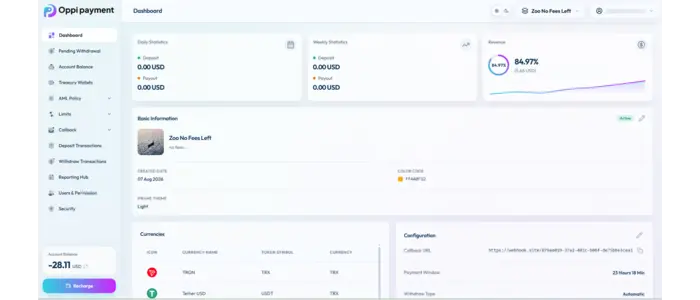
Best for: Businesses that require a specific crypto given by their customer to be sent directly to their wallet.
Overview: Oppi Payment provides a crypto payment gateway that helps businesses to accept and handle cryptocurrency payments. It is non-custodial, which means that your customer's payment will go directly to your wallet, and Oppi Payment will not keep it for you. It is a business product, so it is different from Oppi Wallet, the consumer wallet. If you need complete information, read what Oppi Payment is.
Fees: 0.35% to 0.50% per transaction, with no setup fee and no monthly subscription.
Currencies and networks: Oppi Payment supports 40+ cryptocurrencies, including BTC, ETH, USDT, USDC, MATIC, BNB, and many others, which are supported on various networks, like ERC-20, BEP-20, TRC-20, and SPL.
Custody and settlement: The payments are paid directly into your own wallet in the same coin that the customer earlier paid, and they settle in seconds. Oppi Payment never converts to fiat, so it never keeps custody during a conversion step.
Integrations: The API is the main product. It's supported by an invoice widget, pricing widget, payment button, and payment page, and also by a no-code option.
Pros:
-
0.35% to 0.50% rate with no setup fee or monthly subscription.
-
Non-custodial, with 800k+ wallet addresses served and no lost funds reported.
-
250+ merchants, 99% satisfaction, $5M+ transaction volume, and 14+ years of team expertise.
-
Cyberscope is audited and VASP-licensed in Poland
Want to Receive Crypto Payments Directly in Your Own Wallet at Just 0.35% to 0.50%?
Start Accepting Crypto with Oppi PaymentCons:
-
No fiat settlement, so you manage any conversion and any price movement yourself.
-
You become more responsible for securing your own wallet.
Choose it if: You are in the iGaming and casinos, token sales, forex, e-commerce, marketplaces, fintech, or SaaS industry, and you are ready to accept, utilize, and convert cryptocurrencies on your own; then try Oppi Payment.
BitPay
Best for: Merchants who wish to remain out of crypto and settle for fiat.
Overview: Its business page says it has been "Leading Crypto Payments Since 2011." It converts customer cryptocurrency and settles to you.
Fees: 2% + 25¢ per transaction under $500,000 a month. From $500,000 to $999,999, it is 1.5% + 25¢, and at $1,000,000 or more, it is 1% + 25¢. Higher fees for high-risk industries and the miner fee on refunds are deducted from the miner ledger.
Currencies and networks: 100+ coins across 6 networks.
Custody and settlement: It’s custodial. Both fiat and crypto are available for settlement. Its business page reads, "BitPay will start a bank settlement to you the following business day.
Integrations: Hosted checkout, payment buttons, embeddable invoices, and plugins.
Pros: The price of 25¢ is fixed and applies to small orders. Cons: The 2% tier applies to most smaller merchants, and the 2¢ fee is a disadvantage for small orders. Choose it if you have a high volume and desire to have bank settlement without crypto exposure, then choose it.
Coinbase Business
Best for: US or Singapore companies that want to store or transfer USDC.
Overview: Coinbase Business is a rebrand of Coinbase Commerce. Merchants had until March 31, 2026, to transition.
Fees: It is currently charging a 1% fee for completing any payment from a link, which is detailed in your dashboard. Converting USDC to USD automatically carries a separate fee.
Currencies and networks: USDC on Ethereum, Base, Polygon, Optimism, Avalanche, and Arbitrum. USDT is accepted on Ethereum in the US and certain regions.
Custody and settlement: It’s custodial. Funds deposited in your Coinbase Business account are credited to your USDC wallet.
Integrations: Payment links, invoices, checkouts, payouts, and an API.
Pros: Strong brand, USDC rewards, and accounting tools. Cons: Limited regions, no non-custodial option, and a short token list. Choose it if: The business is located in the United States or Singapore and requires a USDC treasury account. Then it is best to choose it.
Stripe Stablecoin Payments
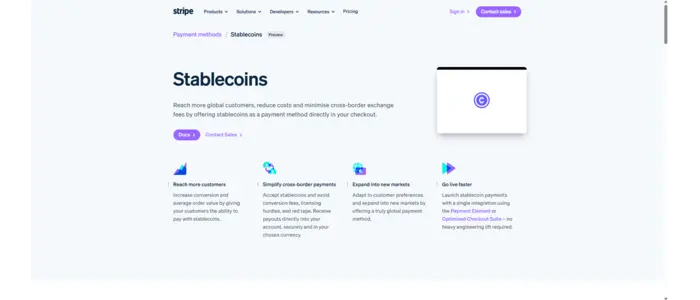
Best for: Businesses who are already using Stripe.
Overview: It adds a "Crypto" option to checkout. Customers are sent to crypto.stripe.com to pay from their own wallet.
Fees: 1.5% of the transaction amount.
Currencies and networks: USDC on Tempo, Ethereum, Solana, Polygon, and Base. USDP (Ethereum + Solana) and USDG (Ethereum) are only available in the United States.
Custody and settlement: Custody and settlement can be settled to your Stripe balance in your local currency. The refunds are back to the customer in the form of stablecoins.
Integrations: Checkout, Elements, Billing (including subscriptions), Invoicing, Payment Links, and Connect.
Pros: No new integration when using Stripe, recurring billing, and no disputes. Cons: Only has stablecoins, a 10,000 USD per-transaction limit, and is available in the United States; other regions are in preview. Choose it if you are a US Stripe merchant and prefer that stablecoins work the same as all other payments.
NOWPayments
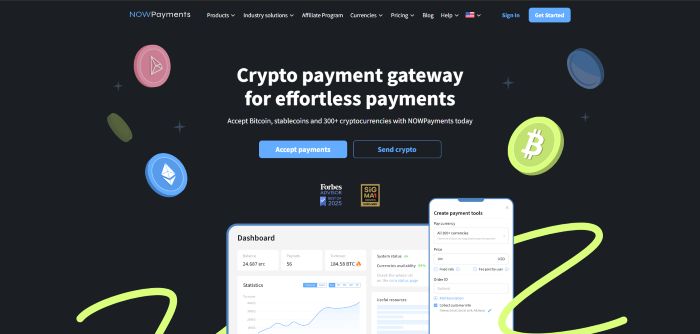
Best for: Merchants who require many altcoins and settlement choices.
Overview: It offers payments, invoices, mass payouts, and custody balances.
Fees: 1% for payments without exchange. 1.5% for multi-currency, fixed-rate, and "fee paid by user" payments. It says partners can have rates as low as 0.3%, the conversion rate is 0.5%, and the payout fee is 0%.
Currencies and networks: Multiple coins. Its own pages present different amounts.
Custody and settlement: Since late May 2026, new accounts are custodial by default. So you can change to non-custodial by adding a payout wallet and disabling custodial processing.
Integrations: API, plugins, payment buttons, widgets, and POS.
Pros: Wide coin coverage and strong payout features. Cons: People who were expecting non-custodial here are surprised by the default, and older reviews list outdated fees. Choose it if: You want lots of coins, and you set the custody on day one.
CoinGate
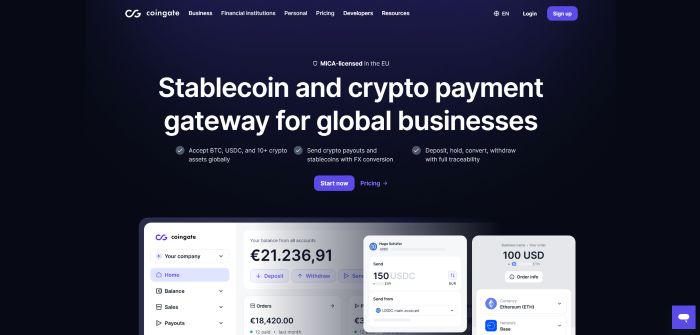
Best for: EU businesses that require a MiCA-licensed provider.
Overview: It is operated by UAB Decentralized from Lithuania.
Fees: From 1%.
Currencies and networks: BTC, USDC, and 10+ crypto assets.
Custody and settlement: Its custodial gateway. The payouts are available to 180+ countries, with payment methods including EUR, USD, stablecoins, and crypto.
Integrations: Plugins such as WooCommerce and WHMCS, plus an API, billing, and refunds.
Pros: Simplicity of EU licensing and fiat settlement. Cons: Shorter coin list and a higher base fee than some of its competition. Choose it if you are selling to customers in the EU and regulations are a priority, then choose it.
BTCPay
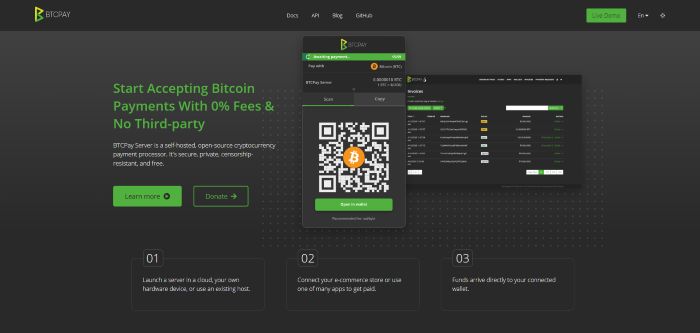
Best for: Technical teams that want a full self-custody model.
Overview: It is free, self-hosted, and licensed under MIT. It calls itself an "open-source project," not a company.
Fees: 0% processing fees. You pay for hosting, and customers pay network fees.
Currencies and networks: Bitcoin on-chain, the Lightning Network, and supported altcoins. Lightning is a faster, cheaper payment layer on top of Bitcoin.
Custody and settlement: It’s non-custodial. Funds are deposited directly into your connected wallet.
Integrations: WooCommerce, Shopify, Magento, PrestaShop, Odoo, Wix, and the Greenfield API.
Pros: No middleman and no processing fee. Cons: You own the server and take it up for its updates and support. Choose it if you have technical staff and value control above convenience.
Cregis
Best for: Large businesses, PSPs, and exchanges that need wallet solutions.
Overview: It has three solutions to offer: MPC wallets, Wallet-as-a-Service, and a Payment Engine. MPC (multi-party computation) splits a private key so that no one has the entire key.
Fees: It states that its payment engine begins at 0.3%, depending on the volume and setup.
Currencies and networks: 85+ tokens and 40+ networks on its infrastructure.
Custody and settlement: It describes the model as MPC-based self-custody.
Pros: Good certifications and large infrastructure. Cons: Enterprise pricing and plan limits to review carefully. Choose it if you're creating a big platform that requires wallet infrastructure, not merely just a checkout, then select it.
Binance Pay

Best for: Businesses that have existing Binance users who are already holding cryptocurrencies.
Overview: Payments go between Binance accounts so that customers don't have to pay on-chain gas fees.
Fees: It charges a 1% fee for Mini Program merchants, plus a $1,000 minimum monthly fee below 90K USD per quarter. Check your merchant agreement for standard checkout rates.
Currencies and networks: 80+ cryptocurrencies for merchant payments.
Custody and settlement: Custodial, inside your Binance merchant account.
Integrations: QR checkout and an API.
Pros: Access to Binance's 30 million Pay users. Cons: Customers should have a Binance account, and it is not available in every region. Choose it if your audience is heavily Binance-based, then choose it.
CoinPayments

Best for: Merchants that need a long-lived multi-coin processor.
Overview: It states on its website that they have been a payment processor since 2013 and provide wallets, plugins, and POS tools.
Fees, currencies, and networks: Its official fees page states that the fees start at 0.5% for coins and 1% for tokens, with the addition that fee adjustments may apply if you're in a high-risk industry. Visit its supported-coin pages to learn about the available currencies and networks.
Custody and settlement: You can receive crypto settlement in three ways. "To Balance" holds your money within your CoinPayments wallet (0.5%). "ASAP Mode" charges "1 network fee for each payment." "Nightly Mode" charges "1 network fee for the whole batch settlement."
Pros: Long history and broad tooling. Cons: Different fees according to asset, and coin lists change. Choose it if you require its specific coin list and are certain that the price is as it is right now. Select it.
6. How to Choose the Right Crypto Payment Gateway
Checklist
-
Make sure you choose one of the three options: crypto, stablecoins, or fiat by the end.
-
Choose custody: do you want to keep your own keys or not?
-
Make a list of the coins and networks your customers actually use.
-
Calculate the overall cost, including fixed fees, conversion fees, and network fees.
-
Check to see if the service provider is legal in your area.
-
Check how it manages underpayments, refunds, and wrong-network payments.
-
Test the integration in a sandbox before launch.
-
Review the security evidence, which includes audits and certifications.
Which Gateway Fits Which Business Type
-
E-commerce store: BitPay or CoinGate are the best options if you are looking for fiat payment options for your e-commerce store. For wallets, consider Oppi Payment and BTCPay for crypto in your own wallets.
-
iGaming and casinos: You require fast deposits and an API-first setup. Read our guide on crypto payments for iGaming and online casinos for more information.
-
SaaS with subscriptions: Stripe provides support for stablecoin subscriptions.
-
Token sales: Presale widgets and invoices are important in token sales. Oppi Payment provides a Presale Widget.
-
Platforms that want their own brand: A white-label crypto gateway can be used by platforms that wish to have their own brand.
Common Mistakes When Choosing a Crypto Payment Gateway
-
Just comparing only headline percentages without considering the fixed per-transaction fee.
-
Taking "non-custodial" without verifying the account's default settings.
-
Maintaining too many networks, which can confuse customers.
-
Ignoring licensing for your region.
-
Not having a written refund procedure.
7. Networks and Stablecoins: What Your Customers Will Pay With
This is something that is usually misunderstood by many beginners: that USDT is one coin. In practice, it is the same dollar token that is issued on multiple different blockchains. USDT is issued by Tether, and USDC is issued by Circle. Both are trying to maintain 1 US dollar parity.
-
ERC-20 (Ethereum): It's a widely supported network and typically the most costly network in terms of a standard transfer when the network is busy.
-
TRC-20 (TRON): One of the most popular and generally the lower cost of transfer compared to Ethereum.
-
BEP-20 (BNB Smart Chain): Typically low-cost and widely used by Binance users.
-
Solana (SPL): Fast and usually has very low transaction fees.
-
Base: Layer 2 network, which is a network that operates on top of Ethereum to enable more affordable transactions. It's widely used by Coinbase.
-
Lightning: A Bitcoin layer for fast and low-value BTC payments.
-
Tempo: Stripe claims that its charges are normally less than 0.001 USD.
Network fees differ by the second, so verify the current fees before quoting numbers to customers. The main point is simple: support the two or three networks your customers are using, and then label them clearly.
8. Crypto Payment Gateway Fees: What You'll Really Pay
The belief that the headline percentage tells the whole story causes most fee surprises. The costs are divided into four parts: processing fee, fixed transaction fee (if applicable), conversion fees, and transaction fee for the blockchain network.
Worked example: If one order costs $1000, and it's paid for in a stablecoin with a processing fee only, before any network fees:
| Provider | Fee rule | Fee on $1,000 | You receive |
|---|---|---|---|
| Oppi Payment | 0.35% to 0.50% | $3.50 | $996.50 in crypto |
| NOWPayments | 1% (no exchange) | $10.00 | $990.00 |
| CoinGate | From 1% | $10.00 | $990.00 |
| Coinbase Business | 1% (payment links, announced) | $10.00 | $990.00 in USDC |
| Stripe | 1.5% | $15.00 | $985.00 in local currency |
| BitPay (under $500,000/month) | 2% + $0.25 | $20.25 | $979.75 |
| Visa/Mastercard credit average (interchange only) | 2.36% | $23.60 | $976.40 |
Basically, the fixed fee penalizes smaller orders, and the conversion fees add up when it comes time to exchange into fiat. A fiat-settling provider will include conversion in the price, while a non-custodial provider will not, and there may be an exchange fee added to the price.
9. Compliance, Regulation, and Tax by Region (2026)
-
European Union: The MiCA transition period will end on 1 July 2026. From this date and onwards, the crypto-asset service providers who offer services to EU clients must be authorized by MiCA. CoinGate is approved by the Bank of Lithuania under the MiCA CASP. Oppi Payment is a VASP licensed in Poland
-
United States: The US Treasury has stated that the GENIUS Act is set to begin on Jan. 18, 2027. It essentially determines the entities that could be allowed to issue payment stablecoins, but also it will help determine which stablecoin providers will be supported.
-
Singapore: Coinbase Business opened its first market outside the United States in Singapore.
-
Tax: In many countries, crypto that you receive as payment is treated as received at the value on the day you receive it, and gains/losses may occur when you resell it. Some rules do apply, and there is a need to keep records that can be exported and discussed with a competent tax adviser.
In short, verify your provider's license in your area, and maintain a clean record from the moment you start doing business.
10. How to Accept Crypto Payments for Your Business: Step-by-Step
Here are the key steps we'll discuss in detail later as we discuss how to accept crypto payments as a business.
-
Choose how to hold custody and divide settlement, whether crypto holdings are in your own wallet or in fiat.
-
Choose two or three coins and networks your customers use, like USDT on TRC-20 and USDC.
-
Select one gateway and finish its sign-up process.
-
If you are using a non-custodial gateway, create a secure wallet for your business.
-
Connect via plugin, payment link, widget, or API.
-
Test with small real payments on each network.
-
Write your refund and underpayment policy.
-
Set up accounting exports and tax records.
-
Teach your support team about network errors.
11. Accept Crypto Payments for Business in 2026: Benefits and Risks
Benefits for Businesses
Many people still believe that crypto checkout is a niche experiment. The data tells a different story. According to a January 27, 2026, study by Harris Poll for PayPal and the National Cryptocurrency Association (NCA), 39% of U.S. merchants are already accepting cryptocurrencies at checkout. 84% also think that crypto payments will be used more widely in 5 years, according to the same survey.
-
Lower processing cost than cards in many cases: The average Visa and Mastercard credit card swipe fee was 2.36% of the transaction in 2025, based on Nilson Report data reported by the Merchants Payments Coalition.
-
No card-style chargebacks: A confirmed blockchain payment cannot be cancelled by a bank. According to Mastercard's 2025 chargeback report, in 2025, the world's transactions will be charged $33.79 billion in global chargebacks, with merchants defining 45 percent of chargebacks as fraud.
-
Global reach: A customer in one country can pay businesses in another without paying card-network cross-border fees.
-
Faster access to funds: In a non-custodial setup, money gets to your wallet as soon as it is confirmed by the network.
Risks to Plan For
-
Price volatility: The value of bitcoin can drop before you use it if you receive it as BTC and keep it. Stablecoins minimize this risk.
-
No automatic refunds: Refunds are payments made to you, and it is your responsibility to transfer them.
-
Customer errors: Wrong networks and underpayments require clear processes.
-
Regulation: Rules are very different from region to region, and they changed a lot in 2026.
-
Key security: If you have your own keys, you lose your funds if you lose your keys.
Bottom line: crypto can also decrease fees and fraud, but only if you plan for volatility, refunds, and compliance from day one.
12. How to Integrate a Payment Gateway in a Crypto Exchange
The requirements of exchanges and trading platforms are different from a shop because deposits are made regularly and each user requires a unique address.
-
Map the flows: user deposits, withdrawals, and internal transfers.
-
Select an API-first provider that can provide a unique deposit address for every user.
-
Decide on custody first, because it impacts your licensing duties.
-
Connect payment notifications to your ledger so balances update automatically.
-
Include AML screening & travel-rule processes as required by your regulator.
-
Set confirmation thresholds per network.
-
Test deposits, wrong-network cases, and withdrawals in a sandbox.
-
Check and resolve every day.
If you're in the middle of creating a platform at this level, then our overview of crypto payment infrastructure is for you.
13. FAQ
What is the best crypto payment gateway?
It depends on what you need. The CoinGate solution is for EU businesses that require MiCA licensing, and the BitPay solution is for merchants who need fiat settlement. Oppi Payment is the best for businesses that receive cryptocurrency payments directly to their wallet with a 0.35% to 0.50% fee.
Which crypto payment gateway has the lowest transaction fees?
Among all the crypto payment gateways in this guide, Oppi Payment charges only 0.35% to 0.50%. BTCPay offers a 0% processing fee because it is self-hosted, though there are hosting fees. Cregis offers rates starting at 0.3% based on volume and setup. Always add network fees and any conversion fees to the comparison.
How to accept crypto payments for a business?
First, select a gateway and decide whether you want crypto or cash at the end. Then finish its onboarding and add a payment link, button, plugin, or API to your checkout. Try out small payments on every network, and formulate a refund policy prior to going live.
What is a non-custodial crypto payment gateway?
It is a gateway that sends each payment directly to a wallet under your control, so the provider never keeps your funds in their hands. Oppi Payment works this way; it provides a non-custodial crypto payment gateway. So your money cannot be controlled by the provider, but you are more responsible for securing your own wallet and keys.
Which crypto payment gateway offers direct wallet settlement?
The non-custodial gateways send each payment directly to your wallet. Oppi Payment also provides a non-custodial gateway, and BTCPay Server does so too; it's software you host yourself. NOWPayments can also settle to your wallet if you add a payout wallet and turn off custody, because new accounts are custodial by default.
Can I accept cryptocurrency without holding customer funds?
Yes. With a non-custodial gateway, the payment goes directly from your customer’s wallet to your own wallet, and the provider never holds it. Oppi Payment works this way. The main trade-off is that you hold your own wallet keys safe and secure, and you convert to cash yourself if you need it.
Which crypto payment gateway supports multiple blockchain networks?
Most of the gateways do, but the lists are different. The Oppi Payment supports 40+ cryptocurrencies across around 5 blockchains, including ERC-20, BEP-20, TRC-20, and SPL networks. So check the network list before you choose any crypto payment gateway.
Are crypto payments reversible?
No. There are no chargebacks with crypto payments, as the payment is final once confirmed on the blockchain, and a bank or card network can't reverse a payment. Refunds are payments sent out from the merchant. For example, Stripe refunds customers their stablecoins back to their original wallet when they withdraw money.
Which gateways are MiCA-licensed?
Among all the providers in this guide, CoinGate is confirmed as a MiCA crypto-asset service provider, authorized by the Bank of Lithuania. Oppi Payment is VASP-licensed in Poland. So make sure to check if a provider is on the active list in ESMA's register at all times.
14. Final Decision: How to Shortlist the Right Gateway
So there is no single best crypto payment gateway, and if someone claims otherwise, they are selling something. So start with these three questions. Do you want fiat or crypto at the end? Do you want to hold your own private keys? Which region are you licensed for?
-
If you need a fiat settlement, shortlist CoinGate and BitPay. Stripe for US stablecoin payments and BTCPay Server for businesses if they want full control.
-
If you want to receive the exact crypto your customer paid, send it directly to your own wallet at 0.35% to 0.50%; then try Oppi Payment.
If you are looking for an easy way to integrate a crypto payment gateway, read our guide on Oppi Payment's crypto payment solution for business to learn more about its features and integration options.